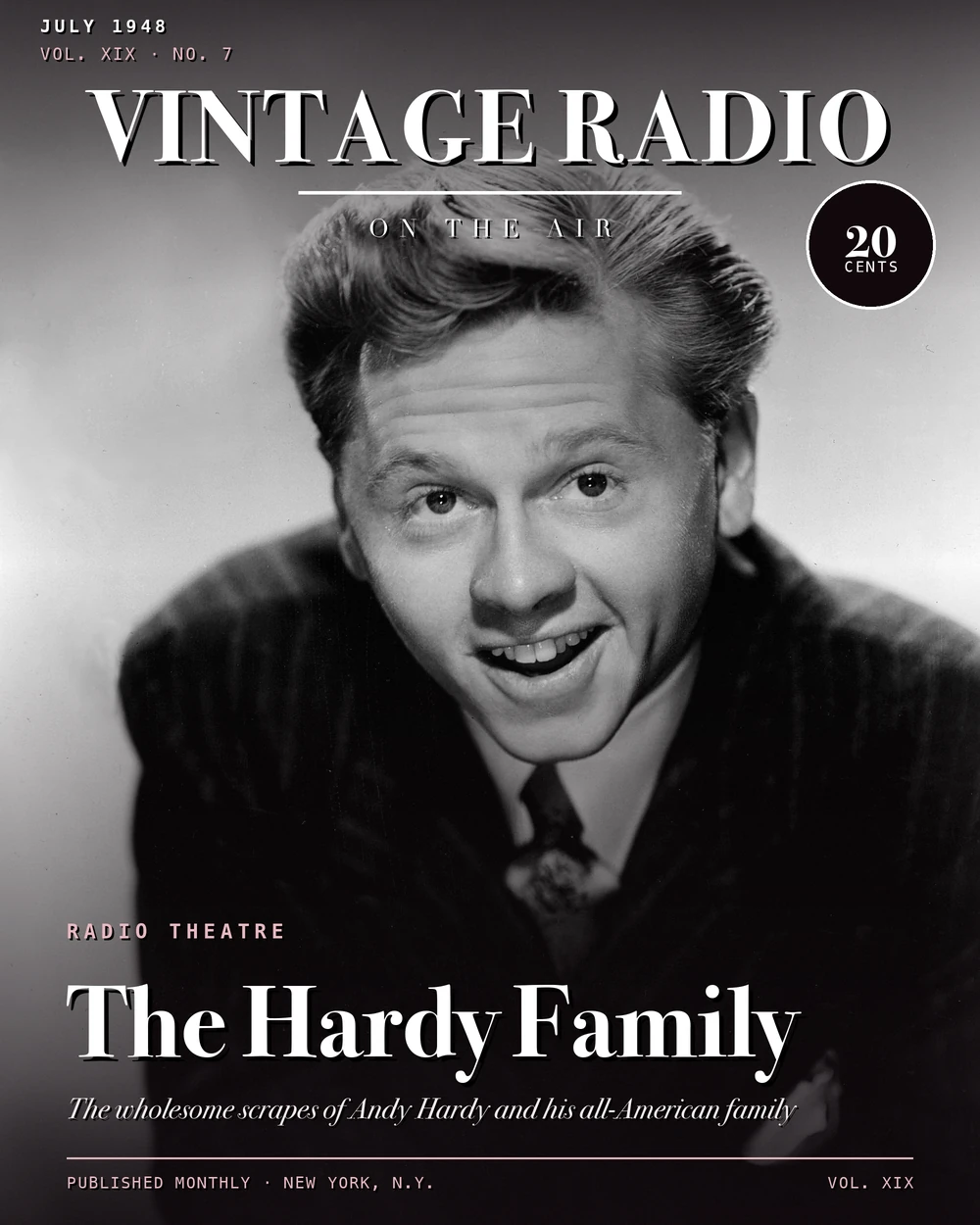
The Hardy Family
From the Screen to the Microphone
In 1942, at the height of the Andy Hardy film series' popularity, the Academy of Motion Picture Arts and Sciences gave MGM a special Academy Award "for its achievement in representing the American Way of Life in the production of the Andy Hardy series of films." That was the franchise behind the radio show — sixteen pictures released across roughly a decade, with Mickey Rooney playing Andy from age 16 in 1937 through age 25 in Love Laughs at Andy Hardy (1946), in which Andy returned from World War II. Translating all that to radio meant bringing along the actors who had come to own those roles: Rooney as Andy, Lewis Stone as Judge James Hardy, and Fay Holden as Emily Hardy. The series debuted in a transcribed syndication run beginning in 1949, then moved to Mutual on January 3, 1952, airing Thursdays at 8:30 for a 30-minute slot until January 1, 1953.
The character had deep roots. Andy Hardy originated in Aurania Rouverol's 1928 stage play Skidding, which opened at the Bijou Theatre on May 21, 1928, and ran until July 1929. The first film adaptation, A Family Affair (1937), featured Lionel Barrymore and Spring Byington as the Hardy parents before Stone and Holden took the roles for the long run. By the time radio came calling, Andy had grown up again: the radio version cast him not as the quintessential 1930s teenager from Centerville but as a young businessman navigating adult life. Radio Life noted that Rooney played the grown-up Andy with the same pandemonium and chaos that had defined the character in high school.
The MGM Syndication Machine
The Hardy Family wasn't a standalone project — it was one of eight programs in the MGM Radio Attractions syndication package, launched September 1, 1949, alongside The Story of Dr. Kildare, The Adventures of Maisie, Crime Does Not Pay, and MGM Theater of the Air. The programs originated on WMGM in New York City (formerly WHN) before being distributed to local stations via electrical transcription discs pressed at MGM Records' own manufacturing plant. Trade ads pitched the package as available to "big stations and little stations," making clear that MGM wanted as wide a reach as possible regardless of market size.
The syndication period ran into trouble. A trade-press account from the 1949–50 season described individual station sales for the package as "dismal" during a recessionary year when broadcast advertising revenues were flat. The solution was to shift from syndication to network distribution: the week of December 31, 1951, Mutual began carrying the full MGM package. Despite a promotional campaign that included shipping gingerbread men shaped like Mutual's "Mr. Plus" trademarks and MGM's Leo the Lion to advertisers and radio editors, the shows found little audience acceptance on the network. MGM abandoned its radio projects in 1952 and turned its attention to filmed television. The Hardy Family's final Mutual broadcast on January 1, 1953, coincided with the studio's general exit from radio.
The Cast and Crew
Jack Rubin and Jameson Brewer wrote the series, and Thomas A. McAvity directed. The music came from Jerry Fielding — born Joshua Itzhak Feldman in 1922 — who at the time was also serving as musical director of Groucho Marx's You Bet Your Life, a job he had taken in 1948. Fielding was blacklisted by HUAC in 1953, which cut short his early broadcasting career; he re-emerged in the 1960s as a film composer and eventually received three Oscar nominations for Best Original Score.
Rooney was described in contemporary sources as having "purportedly produced" the series as part of his arrangement with MGM Radio Attractions, though his official credit was as star. His previous radio outing, Shorty Bell on CBS in 1948 — in which he played an aspiring newspaperman, directed and produced by William N. Robson — had lasted only three months before cancellation. By that yardstick, The Hardy Family's multi-year run represented a relative success for Rooney in the medium.
Stone and Holden reprised their film roles directly. Where the films had also featured Cecilia Parker as Andy's older sister Marian and Sara Haden as Aunt Milly, both characters were absent from radio. Stone's Judge Hardy came across as "a calm voice of reason," while Holden's Emily Hardy was played with "a sort of eccentricity that's reminiscent of a more low-key Gracie Allen." Stone held an MGM contract for 29 consecutive years, from 1924 to 1953 — reportedly the longest contract of any actor with a single Hollywood studio, a distinction noted in the Guinness Book of World Records. He died of a heart attack on September 12, 1953, eight months after the radio series concluded, after running outside to chase away a group of teenagers who had invaded his garden. The Hardy Family was one of the last major projects of his career; when MGM made Andy Hardy Comes Home in 1958, Judge Hardy's death was written into the script.
What Survives
Episode numbers on surviving recordings suggest the radio series ran to more than 70 broadcasts. Only a small fraction is known to have been preserved, making The Hardy Family a sparsely documented entry in the MGM Radio Attractions catalog. The series that the Academy once honored for representing the American Way of Life left a modest audio record — enough to hear what Rooney, Stone, and Holden brought to the microphone, but not enough to trace the full arc of Andy Hardy's grown-up years.